


Artifort
furnishing manufacturer (1890)
Artifort is a designer furniture company that dates back to 1890, when Jules Wagemans opened an upholstery business in Maastricht, the Netherlands. In the 1920s, his son Henricus expanded the business and transformed it into a furniture factory. In 1928, the Artifort brand was born, combining the Latin words ars (art) and fortis (strong, powerful).
In its early decades, Artifort focused on traditional craftsmanship and the production of robust, practical furniture. In the 1950s, thanks to the young designer Kho Liang Ie, the company experienced a true stylistic revolution, beginning to experiment with bolder, more avant-garde forms, consolidating its identity in modern European design.
The arrival of Pierre Paulin in the late 1950s marked a crucial step in the company's philosophy. The design becomes "sculptural," with organic shapes and vibrant colors, focusing on comfort and the artistic expression of the furniture, transforming the seats almost into works of art that combine functionality and a strong visual impact. The innovative and timeless design combines quality craftsmanship with advanced production techniques.
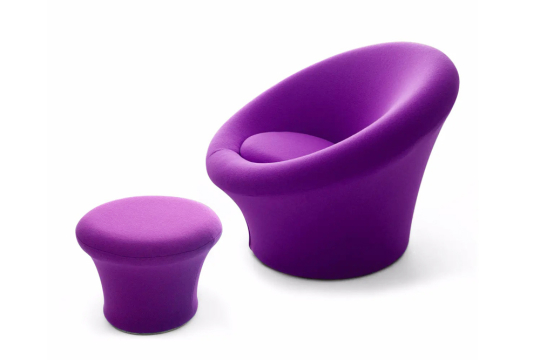
Pierre Paulin plays a key role in the history of Artifort. He began collaborating with the brand in the late 1950s. His influence has been crucial in bringing innovation and modernity to seating design. Paulin creates a wide range of armchairs and chairs characterized by soft, rounded shapes and vibrant colors, often inspired by natural forms such as mushrooms, oysters, and tulips. This style has helped define Artifort's aesthetic identity and consolidate its international reputation in furniture design.
Over the years, Artifort has collaborated with internationally renowned designers who contribute to defining the aesthetic, innovative, and functional identity of its products. Among them, Geoffrey D. Harcourt, Patrick Norguet, Khodi Feiz, René Holten, Jasper Morrison, and Monica Förster, maintaining an experimental vocation while always paying attention to ergonomics, durability, and artisanal quality.
The evolution of Artifort's philosophy can be described as the transformation from traditional artisanal production to modern and experimental design, combining aesthetics, comfort, and quality, emphasizing sustainability and the pursuit of timeless yet functional forms, continuing to innovate without losing the company's strong historical identity.
Artifort is a historic benchmark of European design, with solid roots in craftsmanship and a reputation developed through collaborations with legendary designers who have created furniture recognized for its originality and durability, crafted with innovative materials such as hand-upholstered foams and combinations of metal and controlled-stretch fabric.
Artifort is synonymous with iconic design, with pieces included in the permanent collections of museums such as the Museum of Modern Art in New York and the Centre Pompidou in Paris. It continues to uphold the values of quality, functionality, and craftsmanship, keeping alive a tradition that has lasted over 130 years.
Among the most notable designers are:
Kho Liang Ie, who in the 1950s introduced an innovative vision and expanded the company's international reach.
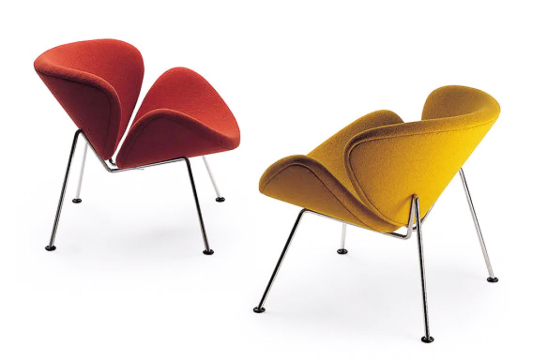
Pierre Paulin, one of the most celebrated, with an innovative and experimental impact, is renowned for chairs and armchairs with sculptural forms and vibrant colors, such as the celebrated Orange Slice, a timeless classic. In the early 1960s, Geoffrey D. Harcourt developed a collection of contract furniture that enabled Artifort's enormous international growth.
More recently, designers such as Patrick Norguet, Khodi Feiz, René Holten, Jasper Morrison, and Monica Förster have continued the Artifort tradition.
Artifort's iconic products:
Mushroom - Chair with an organic mushroom-like silhouette by Pierre Paulin, 1959, exhibited in the permanent collection of the Museum of Modern Art (MoMA) in New York.
Tulip Collection - Series of seats designed by Pierre Paulin, 1960.
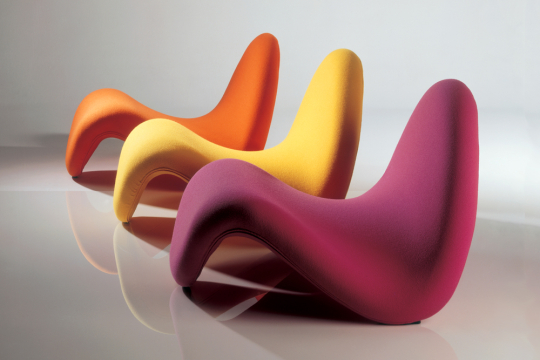
Tongue - Lounge Chair, designed by Pierre Paulin, 1967.
Orange Slice - Sculptural armchair by Pierre Paulin, 1969, composed of two curved elements.
Ribbon Chair - Seat with a tubular metal frame and stretch fabric upholstery, 1966.
C683 - Sofa designed by Kho Liang Ie, 1968.
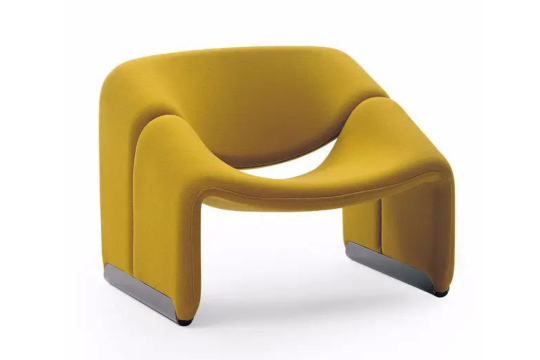
Groovy - Armchair designed by Pierre Paulin, 1972.
Apollo - Seat with an elegant and harmonious design, designed by Patrick Norguet in 2002
Mare - Sofa, designed by René Holten, 2003.
These products represented a turning point in 1960s design, combining enveloping forms and advanced production techniques, helping to elevate Artifort to a benchmark in modern European design.