 never made it to production-grande.jpg)

link esterni:
Contour - Coca-Cola
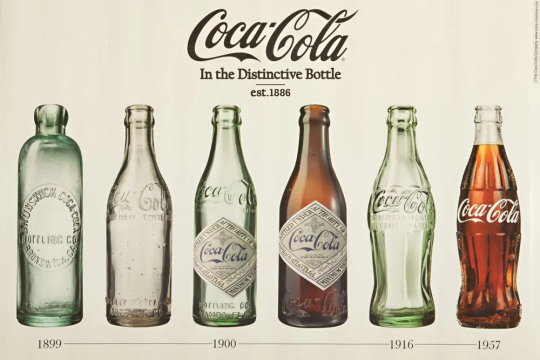
glass bottle (1916)
The Coca-Cola Contour bottle is a design icon, created in 1915 and characterized by its unique shape with curved lines and grooves inspired by the cocoa bean.
Commissioned by Coca-Cola, following a competition, from the Root Glass Company of Terre Haute, Indiana,
The Coca-Cola Contour bottle was designed in 1915 by Earl R. Dean, an employee of the Root Glass Company of Terre Haute, Indiana. Dean's design won the competition held by Coca-Cola to protect the trademark and became a global icon of industrial design.
The project was a team effort led by Alexander Samuelson, foreman at the Root Glass Company, but Dean was the direct author of the linen paper drawing that defined the bottle's final shape.
Its distinctive shape has become known as "the perfect liquid wrapper," appreciated by many artists, such as Andy Warhol, who have celebrated it in their work. The bottle was patented several times, but when the patents expired, the shape was trademarked in 1961, precisely because of its distinctive recognizability. A 1949 study showed that less than 1% of Americans couldn't identify it by its shape alone.
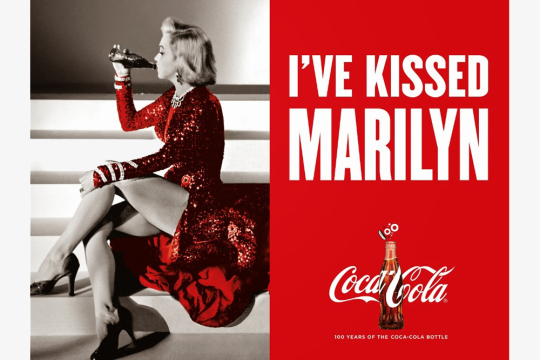
This bottle is not just a container, but a global cultural symbol that represents the Coca-Cola brand in an immediate and universal way, so much so that it has been compared to icons of design and mass culture. One of the most famous shapes in the world is the iconic fluted line of the Coca-Cola bottle. A design classic and described by renowned industrial designer Raymond Loewy as "the perfect container for liquids," the bottle has been celebrated in art, music, and advertising. When Andy Warhol searched for a shape that would represent mass culture, he chose the Coca-Cola bottle.
At the turn of the century, there were many imitators of Coca-Cola. These imitators produced their "cola" in the same bottles as Coca-Cola. Customers didn't know if they were drinking the original. For this reason, the Coca-Cola Co. decided to create a special bottle.
In Terre Haute, Indiana, Root Glass Company director Alex Samuelson spent hours thinking about the new bottle design requested by Coca-Cola. He had an excellent idea. He asked his accountant, Clyde Edwards, to go to the local library to find information on coca leaves.
Samuelson's idea was to create a bottle shaped like one of the ingredients. It would have been unique. But Edwards made a mistake. He likely misunderstood Samuelson because he was Swedish and didn't speak English very well. So Edwards brought the wrong page from the Encyclopedia Britannica, the one dedicated to the cacao tree. The Root Glass Company then designed a bottle with vertical lines and a pronounced belly.
Thus, one of the most recognizable elements in the history of packaging was born. The Coca-Cola Company was very pleased with the new design. They tested a prototype in several factories and, after some technical modifications, launched the bottle nationwide.
The customer now knew with certainty that they were drinking Coca-Cola, "even in the dark." The Coca-Cola Company was satisfied.
In 2015, the bottle turned 100 years old, and to mark the anniversary, Coca-Cola celebrated its history with a limited series of bottles made of aluminum, continuing the company's tradition of using this material for special editions.