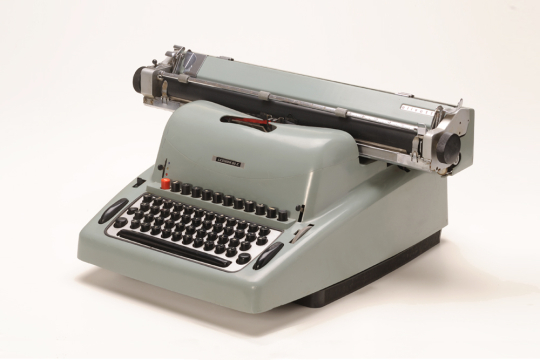


Olivetti
computer systems manufacturer (1908)
The history of the Olivetti (TO) company began in 1908 in Ivrea, where engineer Camillo Olivetti founded the "first national typewriter factory." From the very beginning, it stood out for its technological innovation, high quality, attention to design, and sensitivity to the social aspects of work. These characteristics were strongly desired by the founder and continued by his son Adriano Olivetti, who between the 1930s and 1960s transformed Olivetti into a modern industrial group with international standing.
The share capital consisted mostly of the value of some land and an industrial building owned by Camillo Olivetti that housed C.G.S., a factory of electrical measuring instruments, previously founded by Camillo.
The other shareholders were friends and relatives, whose modest sums were used to purchase the first Brown & Sharpe automatic lathes and the first milling machines, which were selected during a trip to the United States shortly after the company was founded.
Having achieved global leadership in mechanical office products, Olivetti began investing in electronic technology in the 1950s, achieving significant results. The death of Adriano Olivetti (1960) and the burden of investment slowed the transition to electronics.
The world's first electronic typewriter was released in 1978, and the first European professional PC in 1982.
In the 1980s, Olivetti, supported by a vast network of agreements and alliances, accelerated its development in information technology and systems.
The progressive reduction in profitability in the IT business and new developments in telecommunications in the 1990s pushed Olivetti to shift its focus toward this sector, first by creating Omnitel (1990) and Infostrada (1995), and then by acquiring control of Telecom Italia (1999), with which it merged in 2003. Today, Olivetti is the TIM Group company specializing in the "IoT" (Internet of Things), a set of solutions and services that leverage connectivity and network technologies to connect devices and collect data.
Brief description of its history, its iconic and innovative products, their dates, and their designers:
1908: Olivetti is founded. The first Italian typewriter, the M1, is presented in Turin after nearly two years of development, symbolizing the company's launch.
1938: Collaboration with designer and architect Marcello Nizzoli begins, which will influence the design of Olivetti products.
1948: Launch of the Lexikon 80 electronic typewriter and the Divisumma 14 electromechanical calculator, designed by Marcello Nizzoli, both cult products for their innovation and functional design.
1950: The Lettera 22 portable typewriter, designed by Marcello Nizzoli, became an icon of Italian design thanks to its compactness and ease of use. A much-loved and widespread product.
1960: Adriano Olivetti, a key figure in the company's growth, dies, leaving behind a significant entrepreneurial and cultural legacy.
1978: Olivetti launches the ET 101, the world's first electronic typewriter, designed in Ivrea and a technologically advanced product for its time. That same year, Carlo De Benedetti joins the company, revitalizing growth in electronics.
1980s: Development of the first European personal computers, such as the Olivetti M20 and M24. The M24 is particularly successful thanks to its collaboration with AT&T and its meticulously designed design.
Olivetti's focus on design and innovation has often been driven by figures such as Marcello Nizzoli in design and Mario Tchou in technology. The company has also invested in a corporate welfare model and industrial culture that has positively impacted the social and productive fabric.
Today, Olivetti is part of the TIM Group, specializing in digital solutions, the Internet of Things, and innovative technologies, but it still retains the legacy of its pioneering role in industrial design and office technology.