





American design
Industrial Design in the United States
American Design emerged and established itself throughout the 20th century, especially after World War I, with the emergence of the professional figure of Industrial Designer in the 1920s. This category of professionals focuses on the design of mass-produced objects, paying close attention to both technical performance and aesthetics, with the aim of improving daily life and reflecting forward-looking optimism.
American design is a term that emerged in the context of the industrial and cultural growth of the United States between the 19th and 20th centuries, distinguished by a pragmatic, innovative approach oriented toward functional simplicity. Unlike Europe, where design was based on consolidated historical and artistic traditions, in the United States the lack of cultural constraints favored the emergence of a new, free design language closely tied to technological and industrial development.
The term "industrial designer" was coined in 1927 by Ernest Calkins, but the roots of American design extend back to the 19th century, with innovations such as the Balloon Frame (1833), a construction technique that simplified building construction and reflected the country's practical and democratic spirit. Movements such as the Shakers and the production of simple, functional objects represented the first expressions of a distinctively American design, based on accessibility and mass production.
After independence and the American Civil War, rapid industrialization and urban growth (exemplified by the rise of skyscrapers in New York) laid the foundation for a new aesthetic, in which design became an instrument of modernity and progress. In the years between the two world wars, American design asserted itself thanks to the arrival of European designers and the influence of the modernist avant-garde.
In the 1930s and 1940s, figures such as Raymond Loewy, Henry Dreyfuss, Norman Bel Geddes, and Walter Dorwin Teague defined the canons of Streamlining: aerodynamic lines, fluid shapes, and a focus on ergonomics, applied to trains, automobiles, appliances, and everyday objects. The 1934 exhibition "Contemporary American Industrial Art" at the Metropolitan Museum of Art confirmed the central role of these designers, who collaborated with the major companies of the time and shaped the imagery of American modernity.
In the 1930s, many European designers, fleeing Nazism, emigrated to the United States, bringing with them important influences such as Mies Van Der Rohe, Walter Gropius, and others. The Cranbrook School in Michigan became a hub where key figures later flourished.
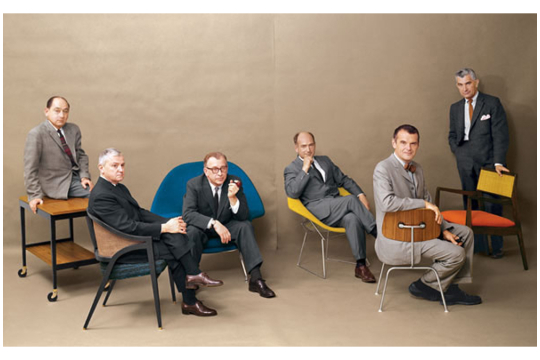
Major corporations such as General Electric, IBM, Ford, Herman Miller, and Knoll became key players in the diffusion of American design, promoting collaboration with innovative designers and architects. In the postwar period, the West Coast stood out thanks to the work of Charles and Ray Eames, who revolutionized furniture and interior design with innovative materials and an experimental approach.
In the field of graphic design, the "New York School," with designers such as Paul Rand, brought American graphic design to an international level, characterized by pragmatism, communicative immediacy, and visual originality.
American design thus developed as a response to the needs of an industrial and multicultural society, emphasizing functionality, mass production, and technical innovation. Over time, it has successfully integrated European influences and local characteristics, becoming a global benchmark for its ability to combine aesthetics, technology, and the market.
Among the most notable designers (in approximate chronological order) are
Norman Bel Geddes, Raymond Loewy, Walter Dorwin Teague, and Henry Dreyfuss: pioneers of the streamlined movement who designed iconic products such as trains, telephones, household appliances, automobiles, Lucky Strike cigarettes (Loewy), airplanes, and hospital equipment.
Charles and Ray Eames: militant designers from the mid-1900s, known for their furniture in innovative materials and organic style, collaborators with Herman Miller.
Eero Saarinen: architect-designer of furniture and buildings, collaborator with Knoll Associates, family of Finnish origin.
Harry Bertoia: designer and sculptor, collaborator with Knoll Associates, known for his innovative furniture.
George Nelson: creative director of Herman Miller, a key figure in the promotion of American design.
Among the iconic companies of American design:
Herman Miller, founded in 1905, a small Michigan company that became a hub of experimental design and production of iconic modern furniture, with the support of great designers such as Eames and Nelson.
Knoll Associates, a designer furniture manufacturer that collaborated with Saarinen and Bertoia.